

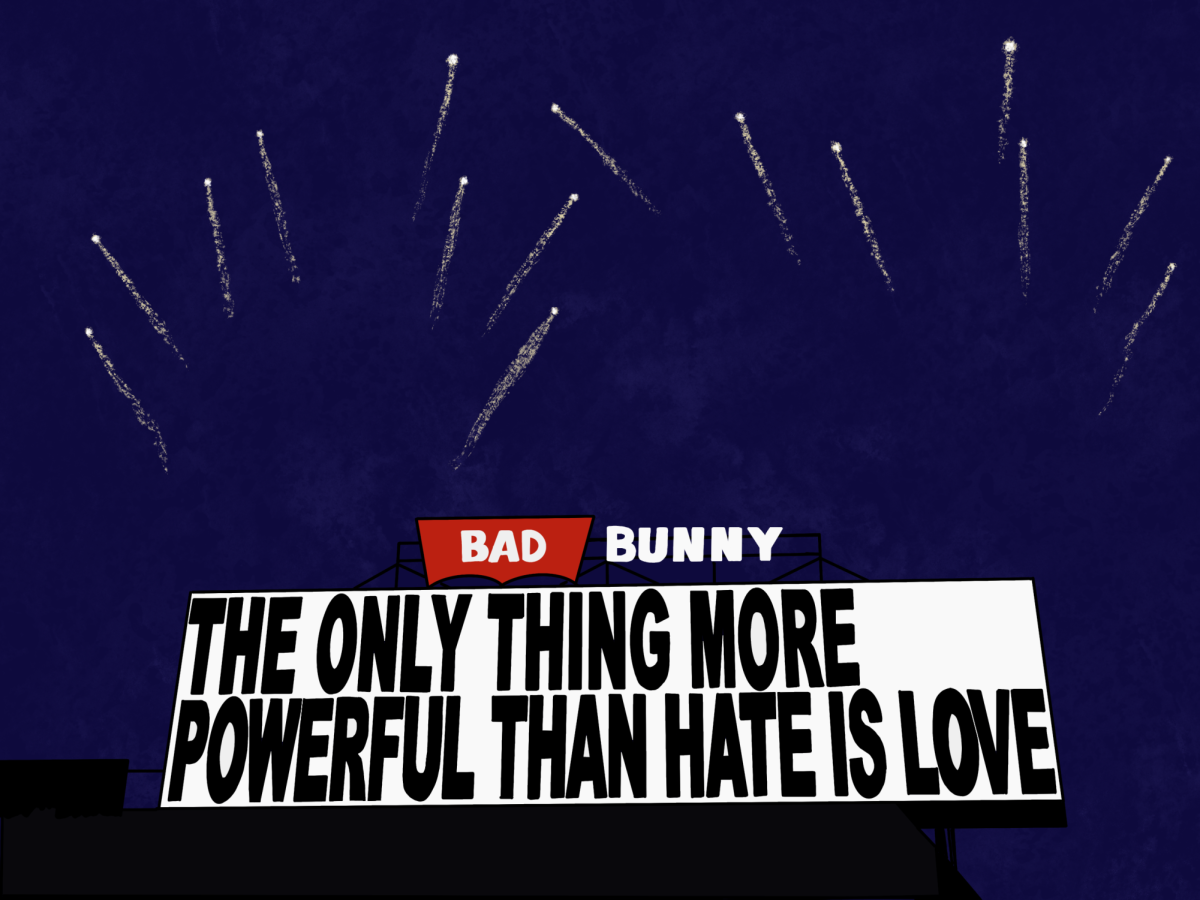
The National Football League (NFL) announced on Sept. 28, 2025, that Benito Antonio Martínez Ocasio, known as Bad Bunny, would headline the 2026 Super Bowl halftime show on Feb. 8.
He isn’t a surprising or risky choice from a musical standpoint. He has 16 nominations and six wins at the Grammy Awards in addition to 52 nominations and 17 wins at the Latin Grammy Awards and was Spotify’s most-streamed artist in 2025 with 19.8 billion streams.
On Feb. 1, a week prior to his performance, Ocasio became the first artist to win Album of the Year with a fully Spanish album, “DeBÍ TiRAR MáS FOToS,” at the Grammys.
Critics were concerned that Ocasio’s commitment to performing entirely in Spanish would impair their understanding and that his message would be perceived as a political statement, given his recent political activism, including criticism of Immigration and Customs Enforcement (ICE).
Yet, NFL commissioner Roger Goodell and league officials stood firmly by their decision.
Conservative nonprofit Turning Point USA (TPUSA) responded with its own alternative halftime show branded to spotlight “American culture, family and faith.” On the organization’s website, viewers could vote for their preferred genres– ranging from hip-hop, pop, country, classic rock, worship or “Anything in English,” a jab at Ocasio’s all-Spanish discography.
As a Puerto Rican, my mother was thrilled at the prospect of her heritage being elevated on a national stage. I, on the contrary, wasn’t expecting much. But when Ocasio’s show opened with a man surrounded by sugarcane, I immediately identified it as the same plant my Puerto Rican grandfather dropped out of school to harvest.
The production and trade of sugar is a major aspect of the island’s history. Enslaved people in the 1500s labored on sugar plantations. Sugar cane production endured centuries after slavery was outlawed, and as of 1964, it accounted for nearly half of overall agricultural sales and made up 23 percent of all wages.
The historical references don’t stop there.
Ocasio walked past a group of older men playing dominoes, young women getting their nails done and people building temporary shelters with cinderblocks, as well as a piragua (Puerto Rican shaved ice) stand.
The stands and pushcarts originated on the island as a way to escape the tropical heat. They were introduced to New York City by Puerto Rican migrants as early as 1926 and grew widespread during the 1940s Great Migration. I recognized it as the same cart my mom worked at as a kid in New Jersey.
Through every detail, down to the Sol de Jayuya symbol inked on a dancer’s arm, our Puerto Rican culture was celebrated and survives because people like Ocasio keep it visible.
Midway through the performance, a beaming couple got legally married on his set. While TPUSA’s intention was to emphasize family, their halftime show failed to visualize the joy that comes with it. You can infer which one that is – they didn’t just hollowly slap the word “family” on a shirt.
Ocasio successfully placed history and real people at the forefront of the country’s most important field. TPUSA’s set relied on lasers, a fog machine and projections of giant flags to specify what counts as American, but lasers can’t manufacture cultural authenticity.
Their show opened with a brief tribute to Charlie Kirk, followed by an electric guitar version of the national anthem by Spencer Waasdorp and artist Brantley Gilbert yelling, “This is real America.”
Defining “real America” strictly through conservative values disregards the stories of all the real Americans Ocasio represented.
As a Tennessean with a U.S. flag in my room, I didn’t feel connected to any ‘culture’ their show claimed to reflect. After Ocasio’s performance, I wanted to add a Puerto Rican flag next to it.
The only English words Ocasio spoke were “God Bless America,” as he listed every country from South America through Central America, the Caribbean and North America – not just the United States.
Meanwhile, TPUSA stated they’re “All-American” only to represent one narrow epitome of a United States citizen– not America itself, the country they claim to love but choose to idealize.
With a platform on more than 3,500 college campuses in the United States, TPUSA’s reach comes with responsibility. The Super Bowl is already a unifying experience where everyone comes together despite everything else that divides us.
TPUSA created a space, attempting to split the year’s biggest viewing audience in two to signal their disapproval of a performer who earned their spot. This is contrary to Ocasio’s message plastered on a screen towards the end of his performance: The only thing more powerful than hate is love.
Following the trend of division, President Donald Trump posted criticism full of unnecessary capitalizations on his Truth Social account about Ocasio’s performance: “It makes no sense, is an affront to the Greatness of America, and doesn’t represent our standards of Success, Creativity, or Excellence. Nobody understands a word this guy is saying, and the dancing is disgusting, especially for young children that are watching from throughout the U.S.A., and all over the World.”
Trump’s statement fails to recognize that America’s greatness stems from the Americans (not just his citizens) who make up the whole continent, only represented by one halftime show.
Not every word had to be in English to recognize Ocasio’s message in the one language everyone speaks, music. What Trump claimed “nobody understands” couldn’t be clearer: celebrating our differences makes us stronger, and unity across cultures is the loudest answer to hate.
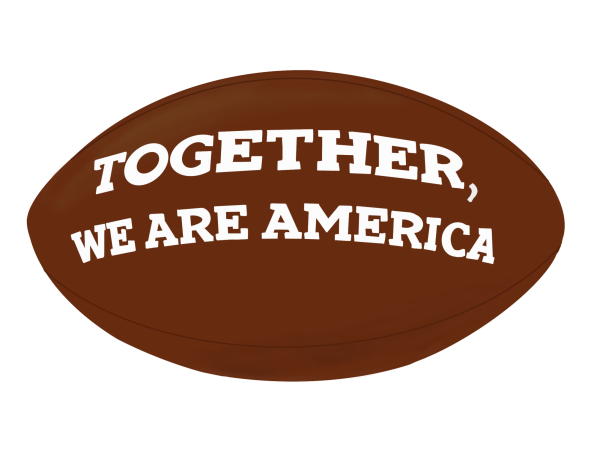
Trump and Turning Point completely missed his point, printed in English on a football:
“Together, we are America.”






Erica Stewart • Feb 17, 2026 at 9:37 PM
Very well written. “lasers can’t manufacture cultural authenticity” had so much more depth to it, I had to read it twice. Great op-ed!
Sienna Lightman • Feb 12, 2026 at 7:47 PM
This is such an incredible op-ed Gabi and Marlon!