

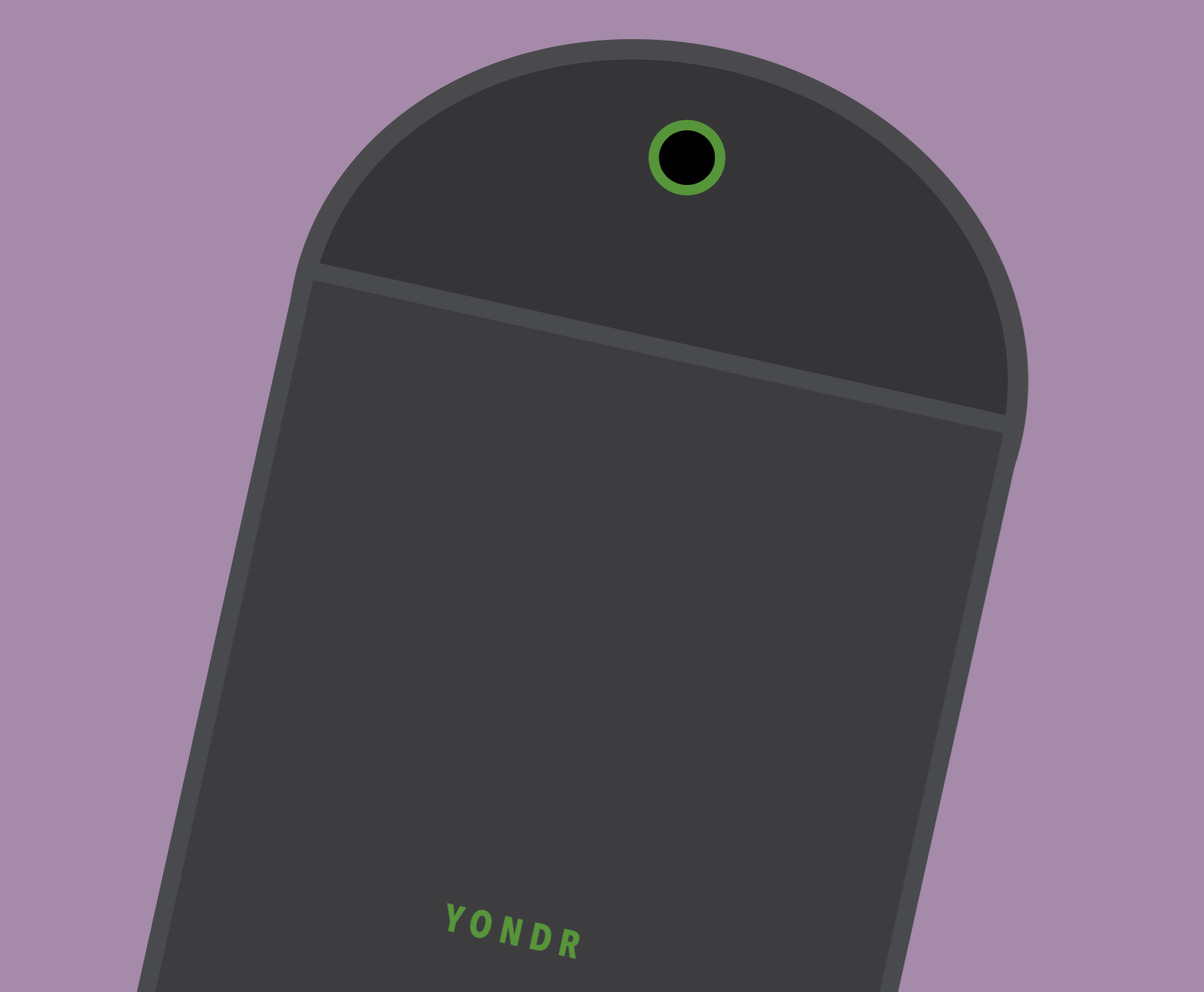
Walking through the halls of St. George’s, the silence is gone. The upper school wing is louder. Students make eye contact across the hallway and conversations spill out of classrooms. QR codes still linger on bulletin boards, relics from a bygone era.
After a trial run during “No Phone November” in 2024, the school made it permanent. On Aug. 8, 2025, Head of Student and Alumni Affairs
Mr. Timothy Gibson announced a year-round phone ban for sixth through 11th graders, enforced through magnetic locking containers known as Yondr pouches.
Middle school students were already familiar with Yondr pouches, but the policy surprised upper school students and received mixed reactions.
Having a phone outside of class was originally a long-standing high school privilege. Administrators assured students that the change was not a punishment, but necessary to comply with a new state law restricting phone use during instructional time, with exceptions for health and accessibility reasons.
The school defines instructional time as the entire day, meaning phones are locked from 8:15 a.m. to 3:15 p.m.
The sudden announcement left many upper schoolers frustrated, including junior John Hudson.
“I saw [the email] and was like, ‘There’s no way.’…I have been here for 13 years and sort of expect[ed] the privilege of having my phone out,” Hudson said, “I’m not necessarily against not having our phones out. I’m more so against the means by which we did so and how abrupt that was.”
Junior Sierra Koontz, who used to study on her phone in the lunch line, was also initially frustrated and worried that Yondr pouches could affect her grades.
“At first, I was really frustrated [with] how that would affect how much studying I can get done during the day…but it hasn’t affected it as much as I thought it would,” Koontz said.
Phones became a senior-specific privilege used exclusively in the Senior Dining Hall.
While they have more phone access than other students, the restriction has still led to worry from some seniors.
“What if my parents were texting me about [something] like a family member dying, and I can’t respond? And then a teacher just takes my phone. Or if it’s an emergency, I think it’s really stupid that I can’t respond unless I’m in a designated part of the school,” senior Saige Williams said.
A year without phones has stirred up concerns about communication in the case of an emergency.
By February, frustration had turned into action. On Feb. 23–24, at the Class of 2027’s Junior Retreat, an annual trip where juniors can propose changes they would like to see made at school, juniors Abby Albonetti, Jillian Beatty, Loxley Hall, Richard Villa, Josiah Hills, Braden Smith, Ve Garles and Emma Whiteley did a presentation about their problems with Yondr pouches.
Their presentation focused on communication concerns and the risks of not having access to a phone in an emergency.
“When you are denied access to your phone all day, every day, you can’t contact anyone in the event of an emergency… It’s just blatantly ignoring the fact that emergencies do happen. No matter how many security guards we have, no matter how much the school values safety, there are always things that you can not plan for,” Albonetti said.
They cited statistics from the K-12 School Shooting Database and Sandy Hook Promise, appealing to the parents in the crowd: Wouldn’t they like to be in contact with their children in the case of an incident at school?
They also explained how not being able to be contacted by a boss or coach could cause students to lose a job or their spot on a team.
“We did not advocate to bring phones back into usage…we are advocating for them to be accessible, but not used. As per state law, phones just have to be away. They don’t have to be in a Yondr pouch,” Albonetti said.
They proposed increasing the concentration of magnets on campus or reverting to cell phone parking lots.
Cell phone parking lots were phone holders in every classroom, used in previous years to limit phone usage during instructional time.
Yondr pouches have been an expensive option compared to other phone restrictors. While the school paid for the unlocking magnets, students without certain financial aid plans were on their own when paying for the pouches. Each Yondr pouch costs $30 at the beginning of the school year and to replace if lost or damaged.
While students already pay for supplies like textbooks, the $30 fee marks a shift from previous phone parking lots, which cost about $10 and were shared. They were also not directly paid for by students.
At St. Mary’s Episcopal School, another private Episcopal school in the Memphis area, students stow their phones away in lockers.
These lockers hold multiple phones at a time, a similar idea to parking lots, but the phones are sealed away behind a door and were not paid for by students.
However, unlike lockers and parking lots, Yondr pouches have a quality that differentiates them: they enable students to be responsible for their own phones throughout the school day.
Dean of Students Dr. Helene Keenan believes that this alleviates some anxiety that came with leaving a phone in the parking lot.
“If [students] have to check out early and they forgot their phone somewhere, they don’t have to run back. [Their] phone is with them at all times … And I think that kind of gives a level of, I don’t want to say security, but comfort [is] maybe too strange a word… At least your phone is with you,” Dr. Keenan said.
However, leaving individual students accountable for their phones has also led to more stress for some students.
“I’ve had multiple dreams where I forgot to put my phone in my Yondr pouch, and I get in trouble for it, and I’m terrified,” Koontz said.
The enforcement of Yondr pouches has been difficult and intense. Phones were easily visible in parking lots, but not in Yondr pouches, making them easier to get around.
During the first class of the day, Dr. Keenan enthusiastically reminds students over the intercom to lock their phones in their Yondr pouches as teachers submit a cellphone accountability form for students missing their pouch. Whether the message feels like a helpful reminder or something more Orwellian depends on the student’s perspective.
“I feel like there [are] people out to get you if you don’t have your phone in there at 8:16 [a.m.], trying to catch people breaking the rules, I feel like it’s more common,” Koontz shared.
According to Yondr’s official website, the pouches promise to “create phone-free spaces where genuine connection, focus, and creativity can flourish in the absence of technology.”
Hudson said interaction has increased, but mostly within existing friend groups.
“No cliques or friend groups are changing whatsoever. There’s no new community…The only thing that has changed is that within those friend groups, they might be closer or talking to each other more,” Hudson said.
Similarly, Williams finds that having phones actually enables people to interact with others.
“I do think people talk to each other way more…but then that leads to people picking certain groups that they want to speak to…I feel like when you have your phone, everyone can agree on something. You’ve shown a video, see your social media, and that can bring numerous people together. And I feel like when you don’t have your phone, you don’t really … talk to other people who maybe [do not] have the same interests as you,” Williams said.
Dr. Keenan views the mission statement as optimistic.
“I’ve heard… [that] students are not distracted, [so] it’s so much easier to go throughout their day and focus without their phones…but we also have our laptops, so we do have technology available. At lunch… students have much more intentional connections and genuine connections,” Dr. Keenan said.
During lunch and study halls, spaces once filled with students on their phones are now centers of conversation. Friends gather in dens, and students interact instead of sitting in their own bubbles.
However, this shift to socialization does come with drawbacks.
Areas like the Upper School Lounge and the lunch line have become louder and more chaotic in the past year. The Upper School Lounge has been closed multiple times due to misuse.
“People are less just chilling on their phones in [the Upper School Lounge] and [are] more actually active and doing things… As a result of that, they’re moving around and not on their phones, but breaking stuff in the process,” Hudson said.
The lunch line is now more controlled, and the Upper School Lounge is permanently closed during lunch and micro.
Although there are still hurdles and unforeseen effects, one thing is clear: the silence is gone.
“Kids are forced to actually interact with one another, and it’s refreshing to see,” Dr. Keenan said. “It’s nice at the end of the day.”



1. Comments must have a verifiable first and last name and email address.
2. Comments may not bully, belittle, or make ad hominem attacks.
3. Comments may not purposefully distract from the subject at hand.
4. Comments may not be used to advertise.